

For several years now I’ve been tackling the final frontier of coaching sport – is there a way we can take all that assumed knowledge you would otherwise gain as a ten-year veteran, and deliver it in a three or four month long campaign?
At risk of ending this essay very early, the answer is “No of course you can’t, it’s called experience, idiot.” If there was a sure-fire way of doing it, I’d be off making dozens of dollars coaching other sports.
But content is content, and I wanted to share some key concepts that I think I’ve tested enough to start sharing with others – how can you help players make better decisions on the field? And I’m going to frame the whole thing with a hacky literary device, using italicised flashbacks to my own experience learning a new sport.
---
When I was 28 I ended a seventeen year long hiatus from footy (Aussie rules). I joined the local club of an area I had just moved to, and was upfront about my almost complete lack of experience. Not to worry, they said, they’re a new club and happy to have anyone who is keen to come along. I trained through pre-season and it wasn’t until round seven that I got called up for a game. I would be playing full forward. I had fifty questions for the coach about how to be an effective full forward. The coach was blunt. “We’re not expecting much out of you, but you’re a big bloke. Just create a contest, and bring the ball to ground. Bretty and Jonno will look after it from there.”
But what if…
“Don’t worry about all that. Just create a contest, and bring the ball to ground.”
So what about when…
“Contest. Ground.”
Being tall, I typically got an extra defender to compete with on leads or marking contests. But I was able to do exactly what was asked about three quarters of the time – I brought the ball to ground – and Bretty and Jonno did indeed take it from there, combining for about ten goals. We won comfortably.
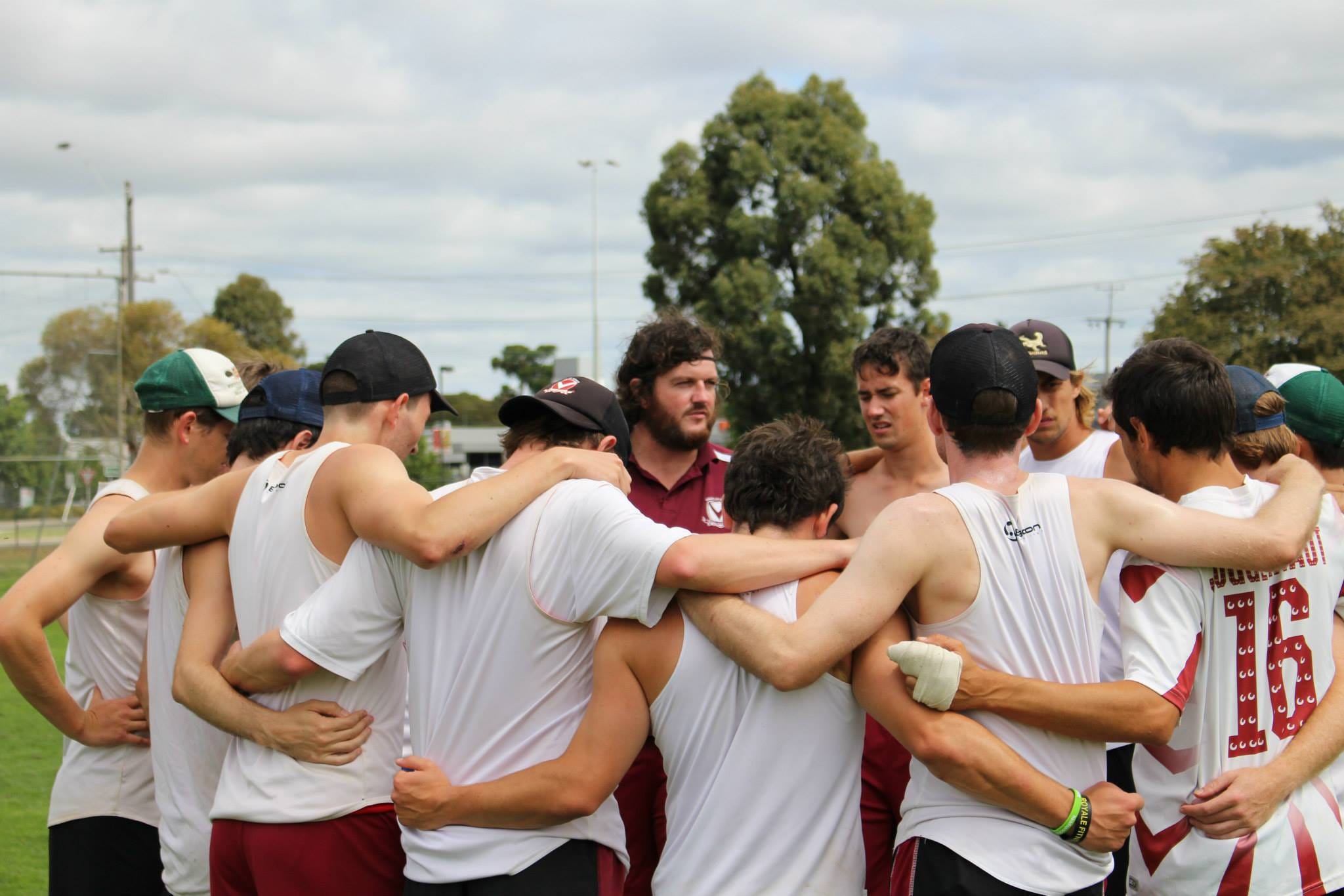
Better Decision Making As A Coach – Minimise The Number Of Decisions That Need To Be Made
The US Air Force uses a model in teaching split-second decision making called the OODA Loop. Outlined briefly, it consists of four phases that feed into each other, and continually loop around.
Observe – the external surroundings. What can you see, hear, feel?
Orient – the internal workings. What do you understand, are you confident or worried, do you take risks, what is the team plan?
Decision – the actual part where your brain goes “I will do this”
Action – carrying out the physical movement
(There are many resources out there on the internet that explain this way better than I ever could, so go and consult them for further detail)
All this happens in less than a second so there’s not much that can be manipulated in terms of process. As a coach, you only really have the opportunity to work with the “Orient” phase. And ultimate coaches tend to be pretty prescriptive most of the time. Stand here. Run there. No, not there. Face this way. Chase that player.
The number of pieces of information that a player will typically process in any given second varies from sport to sport. In ultimate, it’s about 1400. Little, tiny, barely significant pieces such as which direction their team mate who is second from the back of the stack is facing, or where their marker’s left foot is, or how fast the wind is going. As you play more and more, your subconscious mind works out what isn’t important and only feeds through the important things – the “Observe” phase in action. Early on, virtually everything is passed through to the conscious mind, which can be overwhelming most of the time.
Where that is particularly overwhelming for new players is the “Orient” phase, which has a whole slew of “if” and “when” questions to be filtered through. Again, this is all still happening relatively quickly. Newer players to whatever standard of ultimate is being played will tend to seize upon the first coherent combination of “Observe” and “Orient” information they can find and proceed straight to “Decision” and “Action”. And if the defence is doing their job, that combination is probably not a successful one.
Try this little exercise – draw a flowchart of decision making for your team’s current offence plan. What happens with the disc, what happens away from the disc, really get down into the detail. As soon as your flow chart starts looking like the corkboard of a journalist who has uncovered something that goes all the way to the top, man - stop there. Now start to take things out. Things that might only happen once a tournament, at best. Can two or three steps be summarised into one. Get it down to a point where you could present it and have the optimal decision being made, like, 80% of the time.
The more simplified you can make your instructions, the quicker your players are going to be able to adapt to whatever is perceived to be optimal decision making. Give your players room to experiment and develop an “organic” style around two or three basic structural rules, and only intervene if it keeps going wrong. Once they have grown comfortable with the broader structure over time (and I’m talking at least five or six weeks, maybe more), then you can start effectively layering on finer details.
---
After three seasons at my first club, I left to join another club where I had friends already playing. I told the coach I had played as a forward, but he was also blunt with me (very common among suburban footy coaches).
“F---in’ look at the size of them, and look at the size of you. You’re a f---in’ ruckman mate.”
Back to basics. Learning again. Fortunately ruck contests aren’t much different from forward contests, but clearance work (getting the ball away from the pack and into space) was another matter. We settled on a role where I stayed just behind the pack, received the backwards handball, then dish out a lateral handball of my own to an outside runner.
So I need to spot the outside runner and then…
“Just f---in’ handball it. Someone will be there.”
First ground contest happens just inside the centre square. I get behind the pack, the opposing ruckman just off to the side, probably looking to do the same thing from his team. The ball spills out the back and I get first hands on it. My opponent tackles me almost immediately. Without looking I fire out the handball laterally. To my shock it hits a teammate at full pace, he sprints clear of the pack and the ball is in our forward line by the time I get up.
Better Decision Making As A Teammate – Be Consistent In Your Positioning And Movement
They may not be totally aware of it, but new players are constantly picking up pieces of information as they watch drills and scrimmages. How fast teammates are. What their voice sounds like. Where they usually cut from. And cut to. What throws they are good at. Their “Orient” phase of the OODA loop is already developing before they even have a disc in their hands.
The human brain is very, very good at pattern recognition. From the evolutionary need to work out which berries don’t make the bad thing happen, to developing superstitions and conspiracy theories. It is constantly hard at work remembering things that happen twice to store away for later.
Here’s a common scenario all readers will recognise. A league game or pickup is going how ultimate games do. Cuts and defence and what have you. Then a new player catches the disc and all hell breaks loose. There’s three dumps, plus two in-cuts. Defenders poach. Somewhere in the distance, sirens go off. And the new player invariably panics and throws the disc away.
Well that panic is the “Orient” phase going berserk. Why is the dump somewhere else? Why are the cuts all different? Why is everyone shouting “Chilly” at me? Everything that they have been taking in all of a sudden doesn’t match what is going on now. And again as before, they’ll latch onto the first coherent connection they can and push straight to “Decision” and “Action”. Turnover.
The absolute best thing you can do as a teammate to help newer players faster develop decision making skills is to reduce the complexity of the “Observe” phase, so that the “Orient” phase gets a bit more bandwidth. Be consistent in everything you do on the field regardless of who has the disc. Don’t creep in for the dump. Don’t restrict your cutting options. And for the love of all deities, stop shouting at them when they have the disc. Their brain doesn’t need more input to process right now.
Every player creeps in on the newbies. Everyone. Zero exceptions. Don’t tell yourself that you don’t, because you do. I get that it’s intended to reduce the distance, and therefore difficulty, of the throw, but it causes more problems than it solves. It takes conscious, deliberate effort to not do it. Things will still go haywire in the new player’s brain for the first probably two or three weeks, but resist the urges to change your movements. Be patient, because it will start to pay off extremely quickly after that as they continue to pick up your movement patterns.
---
A chance encounter with another club while I was jogging around a park made me realise I was eligible for masters footy, so I moved to my third club. Masters footy is great – less training, games every second week, and rules to discourage some of the physicality and injury risk. The most notable of which is “you cannot leap into a pack with your knees up.” As someone who seldom challenges gravity to a fight, this worked out very well for me. I was suddenly very good at intercept marking across half back. Which exposed a new flaw – I still couldn’t kick very well.
While we did have a coach, it was a very self-managed and collaborative team. The backline crew got together and then presented me with the play – “when you get an intercept mark, we’ll spread wide straight away, and then you just have to hit one of us with a sideways chip kick to get us going.” Beautiful, I thought. A simple instruction, consistent teammates. Now it’s just up to me. So for weeks before and after training, I practised the same move over and over. Overheard mark, push back about 8-10, turn infield, five steps then kick it twenty metres. Mark, back, turn, kick. Mark, back, turn, kick.
It became mechanical. To the point where in games I didn’t even think about it. Mark, back, turn, kick. And we were away into attack.
Better Decision Making As A Player – Practice Your Skills In Context
“Work on your throwing” is never irrelevant advice. Throwing a frisbee is a weird biomechanical action that doesn’t have much use elsewhere in life outside of flicking wet towels at enemies and cross-court forehand smashes in table tennis. So you need to practice. Lots.
Every coach has a name for it, mine is “contextual throwing”. Chucking 30 metre bombs at each other before training is great fun, but how often are you unmarked in a game, throwing to an unmarked receiver? To really make your throwing practice boring you need to apply some context to every throw you do.
Next time you’re at training or league, look for the best thrower on your team as they warm up. They’ll be doing a wide pivot or catch-and-throw or something similar. Go and ask them what they’re doing and why. Actually, let’s save some time and I’ll tell you now. They’re working on their Trapped on the sideline so faking upfield then pivoting behind the mark to hit the break backhand. Or their Dump is cutting up the line so my throw needs to be kinda floaty but not floaty enough that a poach defender can come in and get it forehand. Or their Old mate looks kinda open hammer. Whatever it is, they’re not just throwing, they’re applying context and practicing in that context.
Think about what in-game situation the throw you are practising will apply to. Where would you be on the field? Where is your marker and what is the force? Who are you throwing to and where are they moving from and to? Use your imagination to draw out these scenarios. If the drudgery of adult life has destroyed your imagination, use marker cones.
The endgame here is that your body is programmed to carry out that particular throw, hastening the “Decision” to “Action” part of the loop. Less think, more do. And just to sap all the remaining fun out of it, you need to keep practising it well beyond the point where you think you’ve got it. As I said before, the actions aren’t replicable elsewhere, so you need to keep that muscle memory fresh.
---
This is all just a start - the complexity of the brain is still not really understood. Playing together for a long time is still undefeated at being the best way to develop on-field chemistry. I’m still terrible at footy. But these are, in my recent learning, some simple things you can start doing right now to facilitate better decision making.